Skip to content
Railway axles are critical components that operate under repeated mechanical loads, vibration and fatigue. During manufacturing and machining, surface or near-surface discontinuities may occur in areas such as journals, wheel seats, fillets and other specified inspection zones.
Magnetic Particle Inspection (MPI) is a widely used non-destructive testing method for detecting surface and near-surface discontinuities in ferromagnetic railway axles.
A properly configured railway axle MPI machine can provide controlled magnetization, magnetic particle application and inspection conditions according to the component geometry and applicable inspection procedure.
This article explains the basic MPI process for railway axles, common magnetization methods, equipment configurations and key factors to consider when selecting a railway axle magnetic particle inspection machine.
Why Is Magnetic Particle Inspection Used for Railway Axles?
Railway axles are commonly manufactured from ferromagnetic steels, making them suitable for magnetic particle testing.
During forging, heat treatment, machining, grinding or service, different types of discontinuities may occur on or near the surface.
Depending on the manufacturing process and inspection requirements, possible indications may include:
- Surface cracks
- Fatigue-related cracks
- Grinding cracks
- Forging-related discontinuities
- Heat-treatment-related cracks
- Laps and other relevant surface discontinuities
The actual defects of concern depend on the axle material, manufacturing process and applicable inspection procedure.
MPI is particularly useful when the inspection objective is to detect surface and near-surface discontinuities in ferromagnetic components.
Typical Inspection Areas of Railway Axles
The inspection areas depend on the axle design and the customer’s inspection procedure.
Common areas that may require magnetic particle inspection include:
- Journal areas
- Wheel-seat areas
- Fillets and transitions
- Machined surfaces
- Shaft sections
- Other specified critical areas
Not every railway axle requires inspection of the entire surface. The required inspection zones should therefore be clearly defined before selecting or designing the MPI equipment.
For a customized railway axle MPI machine, the axle drawing is particularly useful because it allows the equipment configuration to be designed around the actual inspection areas.
Magnetic Particle Inspection Process for Railway Axles
The exact process depends on the inspection procedure, magnetic particle system and equipment configuration. A typical wet magnetic particle inspection process may include the following steps.
1. Surface Preparation
Before MPI, the inspection surface should be sufficiently clean.
Oil, grease, dirt, loose scale and other contaminants can interfere with magnetic particle application and indication evaluation.
The cleaning method should be selected according to the condition of the component and the applicable inspection procedure.
2. Magnetic Particle Application
After the railway axle is positioned in the inspection area, magnetic particle suspension is applied to the required inspection surfaces.
For wet magnetic particle inspection systems, the suspension may be applied through a spray or flood application system.
Depending on the inspection procedure, the system may use:
- Visible magnetic particles
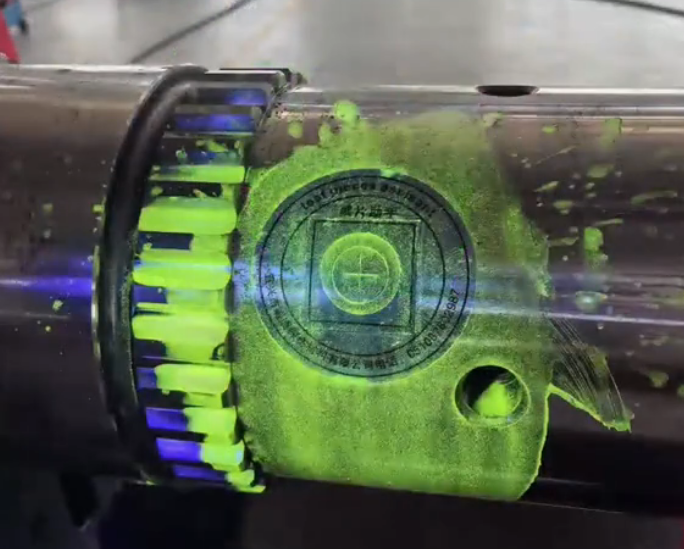
- Fluorescent magnetic particles
For fluorescent MPI, the inspection area is viewed under controlled UV-A illumination during the inspection stage.
3. Magnetization
While the magnetic particle suspension is applied, the railway axle is magnetized according to the applicable inspection procedure.
The magnetization direction is an important factor in MPI because indications are most readily detected when a discontinuity is oriented approximately perpendicular to the magnetic field.
Different magnetization directions may therefore be required to provide suitable sensitivity to discontinuities with different orientations.
The required magnetization method depends on:
- Axle geometry
- Inspection areas
- Expected discontinuity orientation
- Material properties
- Applicable inspection procedure
4. Inspection and Evaluation
After magnetic particle application and magnetization, the inspection areas are observed for relevant indications.
For visible magnetic particles, suitable white-light conditions are used.
For fluorescent magnetic particles, the inspection is performed under controlled UV-A illumination and appropriate ambient-light conditions.
Indications should be evaluated by qualified personnel according to the applicable acceptance criteria and inspection procedure.
5. Additional Magnetization
If the inspection procedure requires more than one magnetization direction, the axle can be magnetized again using a different magnetic field direction.
For example, a combination of circumferential and longitudinal magnetization may be used to improve sensitivity to discontinuities with different orientations.
The exact sequence and parameters should be established by the applicable inspection procedure.
6. Demagnetization
After inspection, the railway axle may need to be demagnetized.
The required demagnetization method and residual magnetic field level depend on the applicable specification and subsequent manufacturing or assembly requirements.
Magnetization Methods for Railway Axles
Magnetization is one of the most important considerations when designing a railway axle MPI machine.
The selected magnetization method should correspond to the inspection areas and expected discontinuity orientations.
Circumferential Magnetization
Circumferential magnetization produces a magnetic field around the axle.
It can provide suitable sensitivity to discontinuities that are oriented approximately parallel to the axle axis.
For many shaft-type components, current is passed through the workpiece or an appropriate electrical circuit to produce the required magnetic field.
The actual current level should be established according to the component, inspection procedure and qualified testing method rather than simply using a fixed value for all axles.
Longitudinal Magnetization
Longitudinal magnetization produces a magnetic field along the length of the axle.
This provides sensitivity to discontinuities with orientations different from those detected using circumferential magnetization.
A coil or another suitable magnetizing arrangement may be used depending on the equipment design.
Multi-Directional Magnetization
A railway axle may require more than one magnetization direction if the inspection procedure requires detection of discontinuities with different orientations.
A customized MPI machine can therefore be designed with both circumferential and longitudinal magnetization functions.
The final configuration depends on the axle geometry, inspection areas and applicable requirements.
Railway Axle MPI Machine Configuration
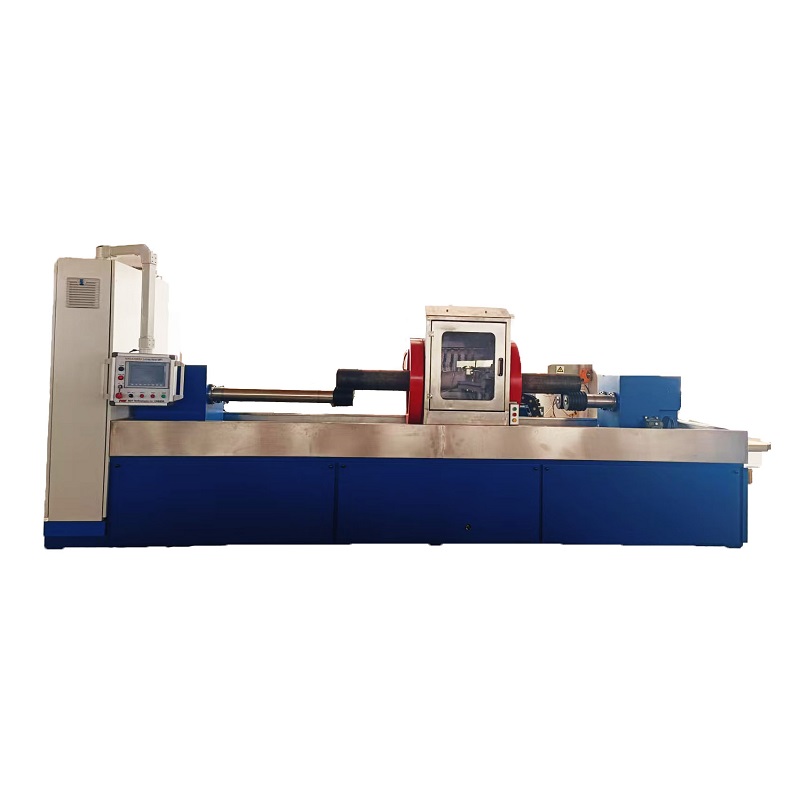
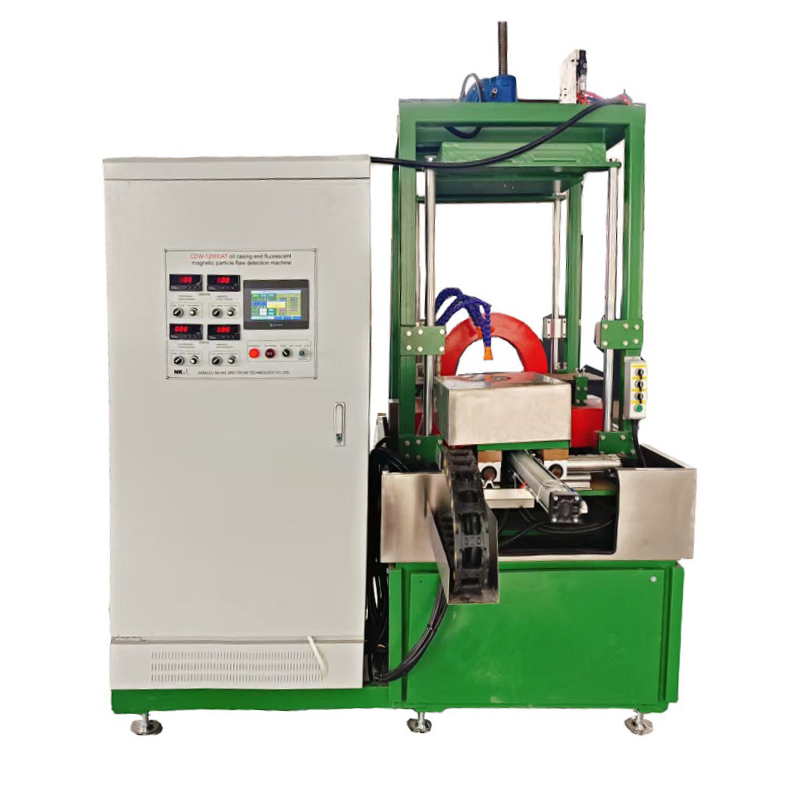
A railway axle magnetic particle inspection machine may integrate several functional systems.
Workpiece Positioning
The equipment provides suitable supports, electrodes or positioning mechanisms for the railway axle.
The mechanical design should take into account the maximum axle length, diameter and weight.
Magnetization System
The magnetization system provides the required current or magnetic field for the selected inspection method.
Depending on the application, the equipment may include separate circuits or functions for circumferential and longitudinal magnetization.
Magnetic Particle Application System
A spray or flood system can apply magnetic particle suspension to the required inspection areas.
The application method should provide adequate coverage while allowing the operator or automated system to control the inspection process.
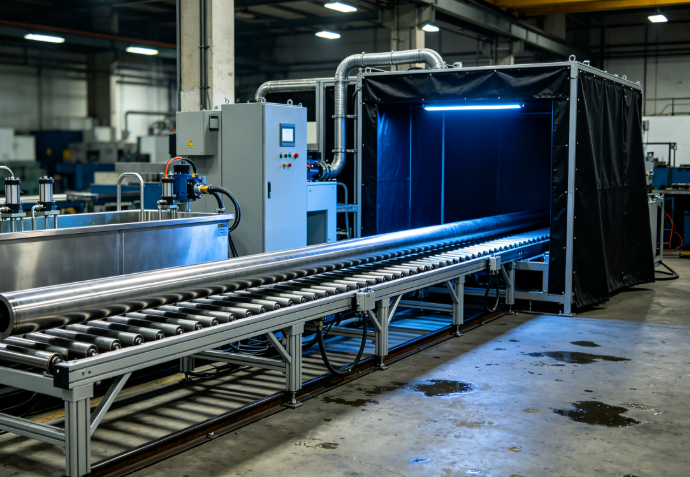
Inspection System
The inspection area should provide suitable lighting for the selected magnetic particle method.
For fluorescent MPI, UV-A lighting and the inspection environment should be controlled according to the applicable procedure.
Control System
The control system can be configured to manage relevant inspection parameters, such as:
- Magnetization current
- Magnetization time
- Inspection cycles
- Magnetic particle application
- Demagnetization
The actual functions depend on the equipment configuration.
Demagnetization System
Where required, the machine can incorporate a demagnetization function after inspection.
Manual, Semi-Automatic and Automatic Railway Axle MPI Machines
The appropriate level of automation depends on production volume, inspection requirements and customer preferences.
Manual Railway Axle MPI Machine
Manual systems are suitable for applications where operators perform workpiece loading, positioning and inspection operations.
They can be useful for lower production volumes, flexible production or applications where manual inspection is preferred.
Semi-Automatic MPI Machine
Semi-automatic equipment can automate selected operations while retaining operator involvement in loading, positioning or inspection.
This configuration can provide a balance between flexibility and production efficiency.
Automatic Railway Axle MPI System
Automatic MPI systems can integrate workpiece handling, magnetic particle application, magnetization and other inspection operations.
For high-volume production, automation can help standardize the inspection cycle and reduce manual handling.
The actual automation level should be selected according to production capacity and the customer’s inspection process.
What Information Is Needed for a Railway Axle MPI Machine?
Before designing or quoting an MPI machine for railway axles, the following information is useful.
Axle Dimensions
Provide the relevant dimensions, including:
- Overall length
- Minimum and maximum diameter
- Journal diameter
- Wheel-seat diameter
- Fillet and transition dimensions
An engineering drawing is preferred when available.
Axle Weight
The maximum and minimum workpiece weight should be provided.
Weight affects the mechanical structure, workpiece support and loading arrangement.
Inspection Areas
Clearly identify which areas need to be inspected.
For example, the requirement may cover the entire axle or only specified sections such as journals, wheel seats or fillets.
Expected Discontinuity Orientation
If the customer knows the expected defect types or orientations, this information can help determine the required magnetization directions.
Production Capacity
The required number of axles per shift or per day is important when determining the appropriate equipment configuration and automation level.
Applicable Inspection Procedure
Customer specifications, railway standards and qualified inspection procedures should be provided whenever available.
The equipment should be designed to support the actual inspection procedure rather than relying only on a general MPI configuration.
How to Choose a Magnetic Particle Inspection Machine for Railway Axles
When comparing railway axle MPI equipment, maximum current is only one factor.
Consider the complete inspection process.
1. Inspection Coverage
The machine should provide effective access to all required inspection areas.
2. Magnetization Direction
Determine whether the application requires circumferential magnetization, longitudinal magnetization or multiple magnetization directions.
3. Workpiece Size and Weight
The machine must safely accommodate the complete range of axle dimensions and weights.
4. Magnetic Particle Application
The application system should provide appropriate coverage of the required inspection areas.
5. Inspection Environment
Visible or fluorescent inspection requires suitable lighting and inspection conditions.
6. Production Cycle
Loading, positioning, particle application, magnetization, inspection and demagnetization all contribute to the overall inspection cycle.
7. Automation
Select manual, semi-automatic or automatic equipment according to production requirements.
8. Customized Engineering
If the axle dimensions or inspection requirements are unusual, customized MPI equipment may be more suitable than a standard machine.
Customized MPI Equipment for Railway Axles
Railway axles can differ significantly in size, geometry, inspection areas and production requirements.
For this reason, a railway axle MPI machine is often designed around the actual workpiece rather than selected only by a standard equipment model.
NEWK can develop customized magnetic particle inspection equipment according to:
- Axle drawings
- Workpiece dimensions
- Workpiece weight
- Inspection areas
- Magnetization requirements
- Magnetic particle application method
- Production capacity
- Automation requirements
- Demagnetization requirements
- Applicable inspection procedures
The final equipment configuration should be determined after reviewing the actual component and inspection requirements.
Railway Axle MPI Machine Manufacturer
NEWK manufactures magnetic particle inspection machines and customized MPI equipment for shafts, railway axles, rings, bolts, crankshafts and other ferromagnetic components.
For railway axle inspection projects, our engineering team can review the component drawing and inspection requirements to develop an appropriate equipment configuration.
When requesting a proposal, customers can provide the axle drawing, dimensions, weight, inspection areas, production requirements and applicable inspection procedure.
This information helps determine the appropriate magnetization arrangement, workpiece handling system, magnetic particle application method and automation level.
Conclusion
Magnetic Particle Inspection is an effective NDT method for detecting surface and near-surface discontinuities in ferromagnetic railway axles.
The performance of a railway axle MPI machine depends not simply on its maximum current, but on the complete relationship between magnetization direction, inspection coverage, magnetic particle application, workpiece geometry and inspection procedure.
For applications requiring different defect orientations, multiple magnetization directions may be incorporated into the equipment.
Whether the requirement is for a manual railway axle MPI machine, semi-automatic system or customized automatic MPI line, the equipment should be designed around the actual axle and inspection requirements.
Looking for a customized magnetic particle inspection machine for railway axles?
Send NEWK your axle drawing, dimensions, weight and inspection areas to discuss a suitable MPI equipment configuration.